Water has a funny way of becoming invisible in our daily lives. We turn on a faucet, fill a glass, take a shower, and move on. It’s only when something changes that we really start paying attention. A strange taste in the morning coffee. White spots around the sink. A shower that leaves your skin feeling dry. Maybe there’s sediment in a glass after the water has been sitting for a while.
These aren’t necessarily signs of a serious problem, but they are worth noticing. Household water can contain minerals, sediment, chlorine, odors, and other substances that affect its taste, appearance, and how it behaves around the home. The right treatment system can make a noticeable difference, but choosing one isn’t simply a matter of buying the biggest filter you can find.
The better approach is to understand the water first, then choose equipment that fits the actual problem.
Start With Testing Instead of Guessing
Before installing any water treatment equipment, it helps to know what you’re dealing with. Water quality can vary considerably from one property to another, even within the same neighborhood.
Homes connected to municipal supplies may have different concerns from properties using private wells. Some households struggle mainly with hardness, while others notice sediment, iron, unpleasant odors, or taste issues. And sometimes there are several concerns happening at once.
A water test provides a useful baseline. It can help identify the characteristics that matter most and prevent homeowners from spending money on equipment that isn’t really necessary.
This is particularly important because water treatment technologies have different purposes. A softener isn’t a substitute for every type of filtration, and a drinking-water system isn’t necessarily designed to treat the entire house.
Whole-House Treatment Has a Different Job
A small filter attached to a kitchen faucet can be perfectly useful when the main goal is improving drinking water. But if the concern affects showers, laundry, appliances, and other fixtures, treating only one tap may leave most of the problem untouched.
That’s where whole-home filtration can become a practical option. These systems are installed at a central point so treated water can flow through multiple fixtures throughout the property.
For a family, that consistency can be appealing. Instead of remembering which faucet has a filter and which doesn’t, the household gets treated water from the main supply. It can also reduce reliance on several individual filtration devices.
Of course, whole-home treatment isn’t automatically better. The filter needs to be selected according to the water-quality issue. A system designed for sediment won’t necessarily address dissolved minerals, and a carbon filter has different capabilities from other treatment technologies.
In other words, bigger isn’t always better. Appropriate is better.
Drinking Water May Need a More Focused Approach
There’s also a reason some homeowners choose a dedicated drinking-water system even when the rest of the house already has treatment.
Drinking water has a different set of expectations. Taste matters. Odor matters. Some people want additional reduction of dissolved substances beyond what their general household system provides.
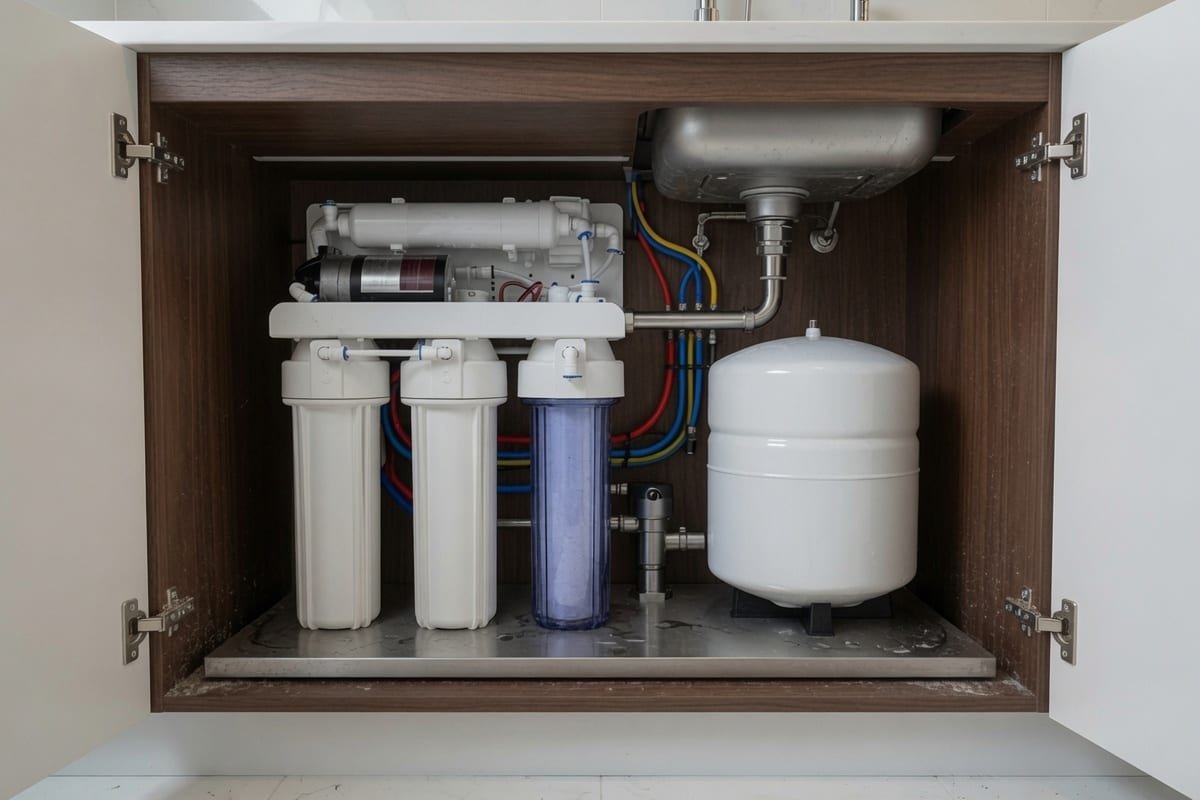
One commonly used technology is reverse osmosis, which pushes water through a semipermeable membrane to reduce a range of dissolved contaminants. These systems are often installed at a kitchen sink or connected to a dedicated drinking-water faucet.
However, reverse osmosis isn’t a magic wand. It requires appropriate installation and periodic replacement of filters and other components. It may also produce some reject water during operation, depending on the system design. For those reasons, the right system should be selected according to the household’s water quality and priorities rather than simply because the technology sounds advanced.
Hard Water Is a Different Challenge
Hard water deserves special attention because it can affect so many ordinary household activities.
Calcium and magnesium are the primary minerals associated with water hardness. Over time, they can form scale on faucets, showerheads, dishes, and appliances. You might notice a cloudy film on glassware or find that soap doesn’t seem to work quite as well.
Water heaters can also be affected by mineral buildup. The impact varies depending on the water, equipment, and operating conditions, but persistent scale is rarely something homeowners enjoy dealing with.
A water softener may be appropriate when hardness is the central concern. Filtration and softening perform different jobs, so understanding the distinction is important when planning a treatment system.
Don’t Forget Sediment
Sediment is another issue that tends to reveal itself in irritating little ways.
Fine particles can enter a home through a private well, plumbing system, or other source. You may notice cloudy-looking water, particles collecting in a glass, or reduced flow through certain fixtures.
A properly selected sediment filter can help capture these particles before they travel farther into the home. In some systems, sediment filtration is used as a preliminary treatment stage before other technologies.
This layered approach makes sense because no single filter has to do everything. One stage can handle larger particles while another focuses on taste, odor, hardness, or dissolved substances.
Maintenance Is Where Good Systems Stay Good
Installing a treatment system isn’t the end of the story. In some ways, it’s the beginning of a long-term relationship with the equipment.
Filters eventually need replacement. Membranes can become less effective. Tanks, valves, connections, and other components may require inspection. Even a system that seems to be working normally can benefit from periodic attention.
That’s why service & maintenance should be considered when choosing equipment, not treated as an afterthought.
Ask how often filters need changing, what routine tasks are involved, and whether professional support is available if something stops working properly. A system that’s easy to maintain is much more likely to receive the care it needs.
Look Beyond the Initial Price
Water treatment is one of those purchases where the sticker price doesn’t tell the whole story.
Two systems may look similar but have very different long-term costs. Replacement filters, electricity, water consumption, installation, repairs, and service can all influence what the system actually costs over several years.
It’s worth asking about these details before making a decision. A slightly more expensive system may turn out to be better value if its components last longer and maintenance is straightforward.
At the same time, don’t assume that the most expensive technology is automatically the most effective. If your main problem is sediment, you don’t necessarily need an elaborate purification setup. Match the solution to the water.
A Practical Way to Make the Decision
If you’re unsure where to begin, keep it simple.
First, test the water. Then identify the problems you actually want to solve. Decide whether those concerns affect the entire home or mainly drinking and cooking water. From there, compare treatment technologies, installation requirements, ongoing maintenance, and total ownership costs.
And don’t be afraid to ask questions. A reputable water-treatment professional should be able to explain what a system removes, what it doesn’t remove, how often it needs service, and why it’s appropriate for your particular water.
That kind of explanation is much more useful than a sales pitch full of impressive-sounding terminology.
Better Water Starts With the Right Fit
There isn’t one perfect water-treatment system for every household. Water quality is personal to the property, the plumbing, and the people living there.
For some homes, basic filtration may be enough. Others may benefit from whole-house treatment, softening, or a dedicated drinking-water system. The goal isn’t to create the most complicated setup possible. It’s to create one that addresses the actual concerns without unnecessary expense or complexity.
Once you know what’s in your water, the decision becomes much clearer. And when the equipment is properly selected and cared for, clean, pleasant water can quietly become one of those things you stop thinking about again—which, in a way, is exactly what you want.