Water is one of those things we tend to notice only when something seems wrong. A glass tastes slightly different. The shower leaves spots on the door. There’s an odd smell when you first turn on the tap in the morning. Maybe the water looks perfectly clear, yet you still find yourself wondering what, exactly, is in it.
Those small moments are often what prompt homeowners to start looking into water quality. And once the research begins, things can get confusing quickly. There are filters, softeners, membranes, carbon systems, ultraviolet technology and plenty of products promising to solve every possible water problem.
The smarter approach is less dramatic: understand your water first, then choose a treatment method that actually fits it.
Water Quality Isn’t the Same Everywhere
It’s easy to assume that water from a public supply is identical from one neighborhood to another. In reality, water quality can vary because of the source, treatment processes, plumbing infrastructure, seasonal changes, and even the condition of pipes within a property.
Well water can bring a different set of considerations. It may contain naturally occurring minerals, sediment, iron, sulfur compounds, or microorganisms that aren’t typically associated with treated municipal supplies.
This is why water testing is such a useful first step. Instead of guessing from taste or appearance, homeowners can get a clearer picture of the characteristics that may need attention.
Choosing Water Treatment Systems
The purpose of water treatment systems isn’t simply to make water “cleaner” in some vague sense. Different systems are designed for different jobs.
A sediment filter, for instance, can help capture particles such as sand, silt, or rust. Carbon filtration may improve taste and odor and reduce certain chemicals. Water softeners are designed primarily to address hardness minerals, while reverse osmosis can reduce many dissolved substances from drinking water.
There are also disinfection technologies, such as ultraviolet treatment, that target microorganisms rather than minerals or chemicals.
The key is matching the equipment to the problem. Installing an expensive system that doesn’t address the actual issue is a bit like buying snow tires for a car that never leaves Arizona. Impressive, perhaps, but not especially useful.
A Look at Water in Silicon Valley and the Bay Area
For homeowners and businesses in silicon valley and bay area, water-quality conversations can involve a mixture of practical and regional considerations. Different communities can have different water sources and infrastructure, while properties may also have their own plumbing characteristics.
Some households are primarily concerned about taste and odor. Others may be interested in hardness, mineral buildup, or specific substances identified through testing.
Older buildings can add another layer to the discussion. Plumbing materials, water heaters, and long periods of stagnation can influence the water that ultimately comes out of a particular faucet.
That doesn’t mean every older home has a water problem. It simply means the property itself deserves consideration, rather than assuming the same treatment strategy will work everywhere.
Clear Water Isn’t Necessarily Perfect Water
One of the most common misconceptions about water quality is that clear water must be problem-free.
Unfortunately, appearance tells only part of the story. Some dissolved substances are invisible. Certain odors can be subtle. And some microorganisms can’t be seen without specialized equipment.
That’s why testing is more useful than simply looking into a glass and making a judgment.
It’s also important to understand that not every substance found in water automatically means there is an immediate health danger. Concentration matters, exposure matters, and applicable drinking-water standards matter. A good water professional should explain results in context rather than using alarming language to sell equipment.
Understanding Water Contaminants
The phrase water contaminants covers a remarkably broad range of substances. It can refer to sediment and particles, certain metals, microorganisms, chemicals, minerals, and other materials that may affect water quality.
Because these categories behave differently, there isn’t a single filter capable of removing everything.
For example, a carbon filter may be excellent for improving taste and reducing certain organic compounds, but it isn’t designed to solve every mineral problem. Reverse osmosis can address many dissolved substances, but it isn’t necessarily the best first step for large amounts of sediment. A UV system can be useful for microbial disinfection, but it doesn’t remove dissolved chemicals.
Knowing what you’re trying to remove makes the technology much easier to understand.
Whole-Home or Point-of-Use?
Another important decision is where treatment should happen.
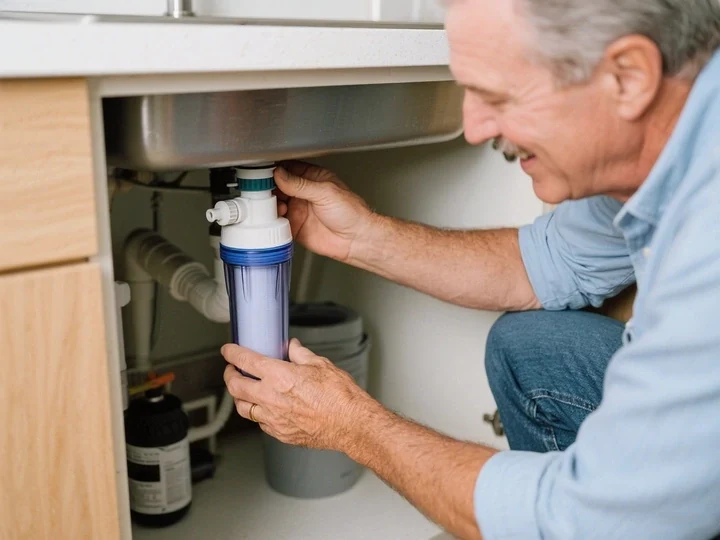
A point-of-use system treats water at a specific location, such as the kitchen sink. This can make sense when the main goal is better drinking and cooking water.
Whole-home treatment works differently. It treats water as it enters the property, so multiple fixtures can receive treated water. This can be helpful when the concern affects showers, laundry, appliances, and other household uses.
Neither approach is automatically better. It depends on the problem.
If the issue is limited to drinking water, treating the entire house may be unnecessary. On the other hand, if hard water or unpleasant odors affect every faucet, a small under-sink filter probably won’t solve the bigger problem.
Installation Matters More Than People Think
A quality treatment unit can still perform poorly if it’s installed incorrectly or sized for the wrong household.
Flow rate is especially important. A system needs to provide adequate performance when demand rises, not just when one faucet is running.
Placement matters too. There needs to be enough room for filter changes, servicing, drainage where required, and access to components. Electrical requirements should also be considered for systems that need power.
Good installation isn’t about making equipment look tidy, although that certainly helps. It’s about making the system practical to operate and maintain for years.
Don’t Forget Maintenance
Every treatment system has a maintenance schedule. Filters need changing. Membranes eventually need replacement. UV lamps have service intervals. Tanks, valves, connections, and other components can require inspection.
Skipping maintenance can gradually reduce performance, sometimes without an obvious warning.
A system that once produced great-tasting water may slowly become less effective as filters become exhausted. Homeowners may blame the equipment when the real issue is simply that routine service was overlooked.
Before purchasing, ask about ongoing costs and maintenance requirements. Know what you can handle yourself and when professional service is recommended.
Good Water Treatment Is About Fit, Not Hype
The best water treatment strategy isn’t necessarily the biggest, newest, or most expensive one. It’s the one that makes sense for the water coming into your property.
Start with testing. Identify the actual concern. Consider how the water is used and whether treatment is needed throughout the house or only at selected fixtures. Then compare technologies based on performance, maintenance, installation requirements, and long-term value.
And don’t be afraid to ask questions. A reputable provider should be able to explain what a system does, what it doesn’t do, and why it has been recommended.
At the end of the day, water treatment should make everyday life simpler, not more complicated. You should be able to fill a glass, turn on the shower, make coffee, or cook dinner without giving the water much thought. That’s the quiet benefit of a well-designed system: it works in the background, doing its job while you get on with yours.