Water has a funny way of becoming invisible in our daily lives. We notice the lights going out, the refrigerator making a strange noise, or the front door sticking in humid weather. Water? We turn the faucet and expect it to simply work.
But small changes can tell a different story. White deposits appear around the sink. The shower glass looks cloudy again two days after cleaning. Laundry doesn’t feel quite the same. Or maybe the water has developed a taste that’s hard to describe, but definitely noticeable.
These things don’t necessarily mean your water is unsafe. Still, they are reasons to take a closer look.
Improving household water quality isn’t about buying the biggest filter you can find. It’s about understanding what’s in the water, deciding what you actually want to improve, and choosing equipment that fits your home rather than fighting against it.
Look at the Source First
Before choosing any treatment equipment, consider where your home’s water comes from.
Municipal water supplies are treated and monitored, but the water can still pick up characteristics as it travels through distribution pipes and household plumbing. Private wells have their own considerations and can vary considerably from one property to another.
Even within the same community, water quality experiences aren’t always identical. Plumbing age, well conditions, local geology and seasonal changes can all play a role.
That’s why testing is such a useful first step. It gives you something concrete to work with instead of relying solely on taste, smell or appearance.
Not Every Water Problem Needs the Same Fix
This sounds obvious, yet it’s easy to forget when you’re browsing treatment options online.
Hard water is mainly a mineral issue, usually involving calcium and magnesium. Sediment is a particle problem. Chlorine taste and certain odors may call for different filtration media. Some dissolved contaminants require more specialized treatment.
A filter designed to capture sediment isn’t necessarily designed to reduce dissolved substances. Likewise, a water softener isn’t a general-purpose filter.
The distinction matters because homeowners sometimes expect one piece of equipment to solve everything. In reality, effective treatment is usually about matching the technology to the problem.
When Whole-Home Filtration Makes Sense
If your concern is affecting several fixtures around the house, treating water at just one faucet may feel like putting a bandage on a bigger issue.
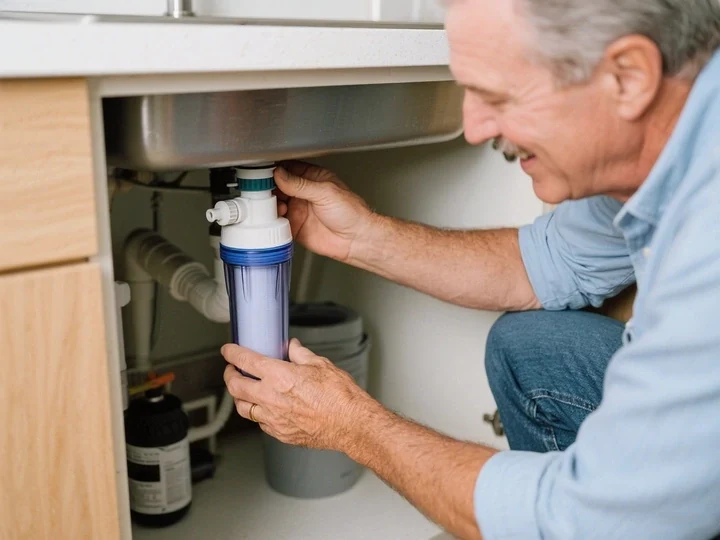
A whole house water filtration system can be useful when homeowners want treated water available throughout the plumbing network. Depending on the equipment, filtration can target sediment, chlorine-related taste and odor, or other specific concerns.
The key phrase here is “depending on the equipment.” Whole-house filtration isn’t one single technology. Different systems use different media and configurations, and their capabilities vary.
Before installation, it’s worth asking exactly what the system is designed to reduce and whether those targets match your water test results. A system should have a reason for being there.
What Does “Pure” Water Really Mean?
The word “pure” gets thrown around a lot in water marketing. It sounds reassuring, but it can also be vague.
In practical terms, homeowners are usually looking for water that is clean, pleasant to drink, suitable for household use and appropriate for their particular circumstances. Pure, safe water doesn’t necessarily mean removing every mineral or dissolved substance.
Some minerals are naturally present in water, and not every dissolved material is automatically harmful. The goal is appropriate treatment, not chasing an unrealistic idea of water with absolutely nothing in it.
This is another reason testing matters. Once you know what’s present, you can decide what needs attention and what doesn’t.
Pay Attention to Flow Rate
A filtration system can be excellent on paper and still be frustrating if it can’t keep up with your household.
Imagine a family of five starting their morning. Two showers are running, someone is washing dishes, another person is filling a bottle, and the washing machine starts its cycle. That’s a lot of water moving through the plumbing in a short period.
Flow rate and capacity should therefore be part of the conversation.
An undersized system may struggle during high-demand periods. An oversized unit may cost more to install and maintain than necessary. Good sizing finds the middle ground.
It’s not particularly glamorous, but it makes a huge difference in everyday use.
Don’t Forget About Installation Space
Where the system goes matters, too.
A garage, utility room, basement or mechanical area might seem like an easy place to install filtration equipment, but there needs to be enough room for servicing. Filters need to come out. Valves need access. Connections may need inspection.
Think about the person who will maintain the system three years from now. If they have to squeeze behind a water heater with a flashlight in their teeth, the installation probably wasn’t planned very well.
Accessibility is part of good design, even if it isn’t something you’ll notice on day one.
Understand Your Household’s Water Filtration Needs
Every home has its own habits and priorities. A household that mostly drinks bottled water may have different priorities from one where everyone fills reusable bottles from the kitchen tap.
Some families care most about taste. Others are concerned about sediment, mineral buildup, odors or specific substances identified through testing.
Your water filtration needs should guide the equipment selection, not the other way around.
It can help to make a simple list before speaking with a water-treatment professional. What have you noticed? Which fixtures are affected? Is the issue constant or occasional? Has anything recently changed?
Those little details can make the evaluation much more useful.
Maintenance Is Part of the Investment
No filtration system should be treated as a set-it-and-forget-it appliance.
Filters eventually reach capacity. Media may need replacement or servicing. Some equipment requires periodic sanitation or inspection. If maintenance is ignored, performance can decline even though the system itself hasn’t technically failed.
Ask about the expected maintenance schedule before you buy. Find out what replacement components cost and whether service is readily available.
A system that is easy to maintain is more likely to be maintained. That’s a simple truth that gets overlooked surprisingly often.
Think About the Long Term
Water treatment is a home improvement, but it’s also a long-term relationship with a piece of equipment.
The initial price is only one part of the equation. Consider installation, replacement filters, electricity if required, water usage, servicing and expected lifespan.
A cheaper system may be attractive at first, but if its filters are expensive or difficult to find, the savings can disappear. Likewise, an expensive system isn’t automatically better.
Look for a sensible balance between performance, reliability and ongoing ownership costs.
Better Water Starts With a Clear Goal
There’s something refreshing about making a home improvement decision without overcomplicating it.
Start with the water source. Test when appropriate. Identify the specific concern. Then choose treatment technology that addresses that concern.
You don’t need to chase every possible contaminant just because a brochure mentions it. You don’t need the largest system in the neighborhood, either.
The best setup is the one that fits your water, your household and your expectations. Once those pieces line up, the difference can be surprisingly noticeable — not because the water becomes some magical substance, but because everyday things simply work better.
Cleaner glasses. Better-tasting drinks. Less buildup. More confidence when you turn on the tap.
Sometimes good water treatment is at its best when you hardly notice it at all.